


Weekly Liturgy : January 12-18


Matthew 1:29-42
NRSV
29-31 The next day John saw Jesus coming toward him and said, “Look, the Lamb of God, who takes away the sin of the world! This is the one I meant when I said, ‘A man who comes after me has surpassed me because he was before me.’ I myself did not know him, but the reason I came baptizing with water was that he might be revealed to Israel.”
32-34 Then John gave this testimony: “I saw the Spirit come down from heaven as a dove and remain on him. And I myself did not know him, but the one who sent me to baptize with water told me, ‘The man on whom you see the Spirit come down and remain is the one who will baptize with the Holy Spirit.’ I have seen and I testify that this is God’s Chosen One.”
35-26 The next day John was there again with two of his disciples. When he saw Jesus passing by, he said, “Look, the Lamb of God!”
37-38 When the two disciples heard him say this, they followed Jesus. Turning around, Jesus saw them following and asked, “What do you want?”
They said, “Rabbi” (which means “Teacher”), “where are you staying?”
39 “Come,” he replied, “and you will see.”
So they went and saw where he was staying, and they spent that day with him. It was about four in the afternoon.
40-42 Andrew, Simon Peter’s brother, was one of the two who heard what John had said and who had followed Jesus. The first thing Andrew did was to find his brother Simon and tell him, “We have found the Messiah” (that is, the Christ). And he brought him to Jesus.
Jesus looked at him and said, “You are Simon son of John. You will be called Cephas” (which, when translated, is Peter).
REFLECTION
from John
This is week two in Epiphany, the period of the liturgical calendar during which we reflect on the mystery of Christ revealed in the incarnation. In our text, we encounter the announcement that Jesus is the Lamb of God, that unfortunate animal demanded in Israel’s sacrificial system.
Curiously, Jesus is God’s lamb. He isn’t identified as the lamb that humanity offers on the altar, but as the one that God brings. Our 21st century ears may not be so shocked by this assertion. But John’s 1st century audience would recognize the scandal within the phrase. For what sins does YHWH need a lamb? And who is demanding the sacrifice here?
There are threads of Christian theology that answers those questions by perpetuating the Jewish sacrificial system, maintaining that God demands sacrifice and death. In this equation, God sacrifices God to… God?
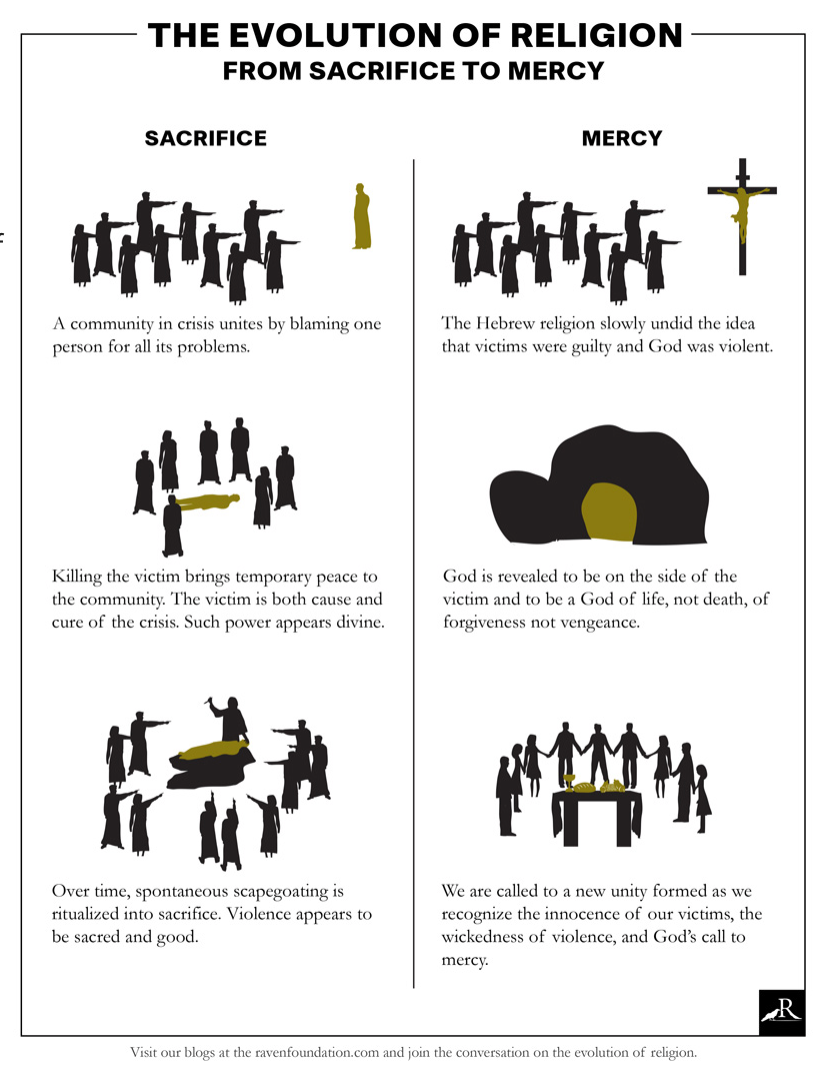
There are other threads that see in this epiphany another revelation: God doesn’t require death and sacrifice at all. Humans do. And Christ, as the Lamb of God, is ultimately revealed as the one who absorbs our violence and, in his resurrection, renders our systems of death impotent and defeated.
I find these threads compelling. And the more I try to follow the voice of Jesus saying “Come, and see,” the more I discover an upside-down Kingdom. One where death really does feel defeated and the worst parts of ourselves become locations for new life. A world where enemies become friends, the marginalized find belonging, and unsheltered neighbors are afforded respite.
This is a world worth participating in. And this is a Lamb worthy of worship.
The Evolution of Religion
The Raven Foundation
PRACTICE:
Outward Mindset Application
Each day this week, look for one small way to be helpful to the people around you without being asked.
Non-Violent Communication Question of the Week
This week, how many times can you replace the word “but,” with the word “and?”
Pathways toward Centeredness
Asceticism (loving God by abstaining from comforts):
Some people love setting goals and resolutions in the new year to exercise more. If you’re one of those people, try thinking of your exercise as prayer. Does it make any sort of difference?
Questions for Reflection
Reflect on your 2025. Do you notice any themes through which Jesus was calling you to “Come and see?”
If Jesus were to ask you, “What do you want?” how would you answer?
“Liturgy” refers to the habits and practices humans use to form community around shared values and meaning. At Church at the Park, we desire to be a community of practice, becoming people who see the world through the eyes of the marginalized, making meaning through the lens of pain and suffering, and committing ourselves to non-violence in a wounded world. This weekly email is intended to provide pathways of practice for becoming the type of people who embody these values.
Many of our reflections on each week's text come from other sources. If you're interested in reading more of what inspires us, here our our two favorite reflections.

Copyright (C) 2023 Church at the Park. All rights reserved.


